You already have superpowers. You can't fly yet.
By Arthur O'Keefe, Founder and Chief AI Officer, Bamboo DCM
Published on

AI is software that iterates with you. Almost everyone has it. Almost nobody can use it yet, and the reason is design. I think that is the next big software opportunity.
Wrong three times in two days
On Thursday I sat through a meeting I'd rather forget. At 6:36 the next morning I sent a colleague a voice note: I thought I'd found a new kind of business. By Saturday the idea had been transcribed, researched, reframed three times, argued over by four AI models from xAI, Google, OpenAI and Anthropic, and scored by a blind panel. Then I read the result and wrote back: this is a really boring story, which tells me it's not the story.
I wasn't frustrated. I was thrilled. I had been wrong three times in two days. Each time I came back, the work was exactly where I'd left it, and I was a little stronger than when I left.
Almost nobody has felt that yet, and the reason is design. Software that iterates with you exists; I run my work on it. The version you can get today was tuned for people who have already spent six months learning it. Fixing that is the next big software opportunity, and it's the work I've taken on.
The superpowers came first

Remember teenage Clark Kent in Smallville? The powers show up years before he knows what to do with them. He can't fly for seasons. He breaks things. He hides.
That's where most of us are with AI. The models I run my work on are the same ones anyone with a laptop can sign up for this afternoon. Almost nobody is flying. In the United States, half of adults tell Pew they're more concerned than excited about AI. In the Reuters Institute's six-country survey, about a third use it weekly. Two-thirds don't. From where they stand the horizon looks flat, and the honest question is whether the whole thing is overhyped.
I don't think you win that by arguing the world is round. You win it by walking someone past the horizon and handing them something they can use once they're there.
"I already have that"

The most common thing I hear from capable, successful people is some version of: I already have that. I haven't felt the leap.
It's honest. They do have a system. It's the one that got them here, built around how they already work. So the new thing looks like a copy of what they own, and the sensible plan is to upgrade their own setup first.
The tell is in their questions. They keep asking for things the new system would already answer. That empty space doesn't mean the tool failed. It means it hasn't been used yet. And I've learned that pushing harder doesn't close it. Every good argument I make becomes one more thing to agree with and postpone.
What works is smaller. Make the first use fit inside a day that already feels full. Take the question the person is already carrying and answer that one. Any first use counts, including using the system to build the case against my own plan. Especially that one. The moment they use it, they're no longer just watching, and often what comes out isn't yes or no but a third option neither of us had.
The next turn
Here's what I think most people misread about the last three years.
Google already answered questions. It already used AI to finish your sentence, and it could handle a follow-up if you spoke to it. When ChatGPT arrived, its own builders at OpenAI told MIT Technology Review that the model underneath was not a fundamentally more capable one than what they had already shipped. The answer was already for sale. What people fell for was the next turn: you could say "not quite," and the thread held. You could push back, change your mind, come back tomorrow, and the work was still there.
Geoffrey Moore gave software two names that stuck: systems of record, the ERP that stores what happened, and systems of engagement, the software that connects people. a16z, Microsoft and Futurum are among those racing to name the next layer: systems of intelligence, of action, of agency. Most of the names describe what the software knows or what it does while you're not looking. Moore himself calls AI an evolution rather than a revolution.
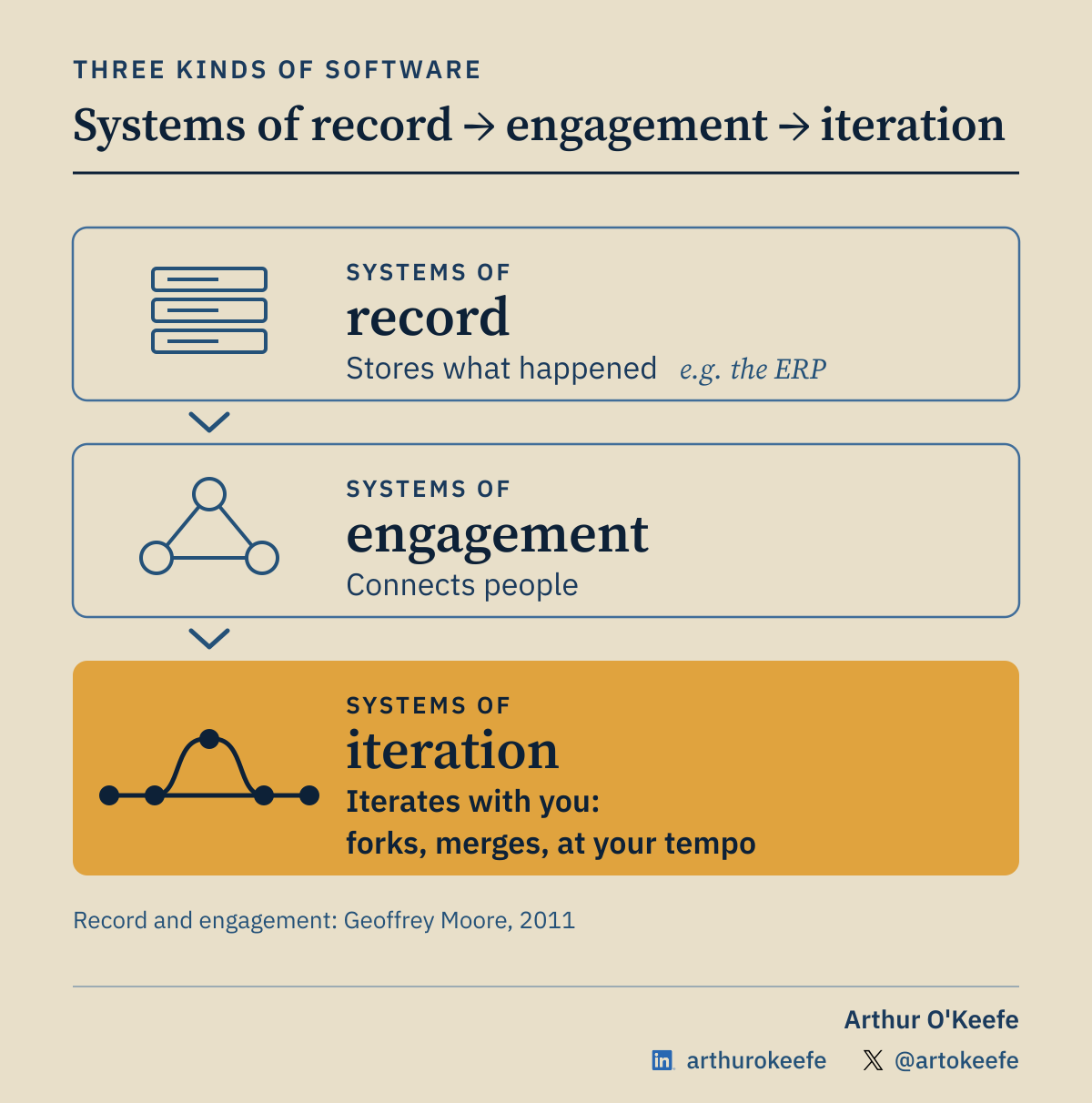
On that point I disagree. What I use every day feels like a third kind of software, and I haven't found anyone using the name: a system of iteration. It gives and takes. When I hit a wall it forks with me down a side path, and when the side path pays off it helps me merge back to the main line. It runs at whatever tempo I choose: flat out for a weekend, or parked for a week while something blocks me, then right back to work without a warm-up. Programs used to run in straight lines. Life comes in waves. This is the first software I've used that moves the way life does.
The map is black
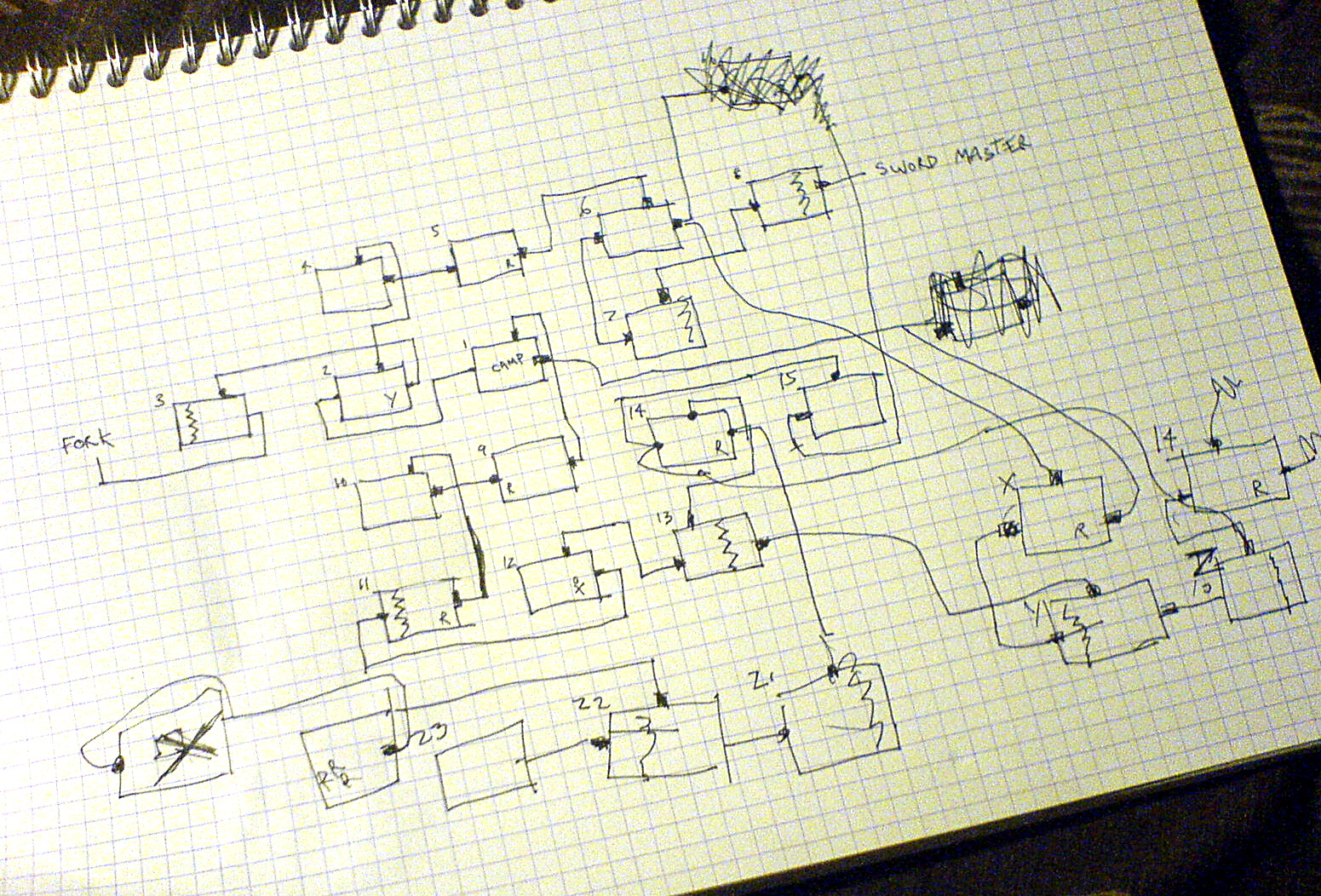
If you played Zelda as a kid, you know the feeling. The map starts black. You hit a locked door and can't go further. So you go somewhere else, clear a side quest, find a key, and come back to a door that now opens onto a new world.
Iteration works the same way. Every loop does two things at once. It lights up a little more of the map, and it leaves you stronger: a tool you built, a resource you found, a key for a door you passed three months ago. By the time you reach the hard region, you can get through it. In Portuguese we say you superar it, and the word carries more force than "overcome."
Airdropped straight into that region on day one, you'd lose. The path is the power-up.
My episodes
Here is what my path looks like, measured.
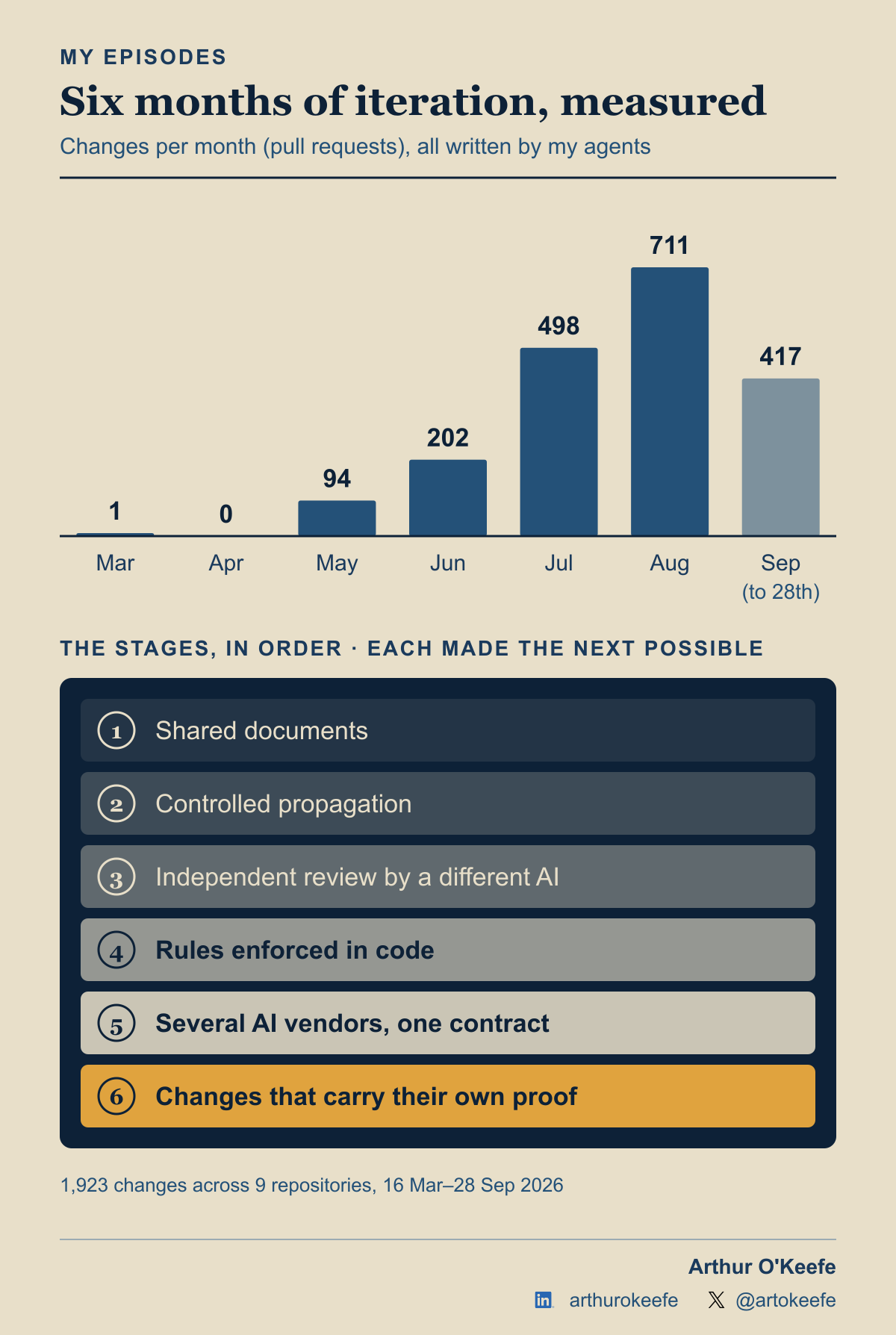
Since March, my agents have written 1,923 changes across nine repositories. Every one of them. There were 94 in May and 711 in August. Nobody planned September's work in March; it wasn't visible from there. First came shared documents. Then changes that propagate from one place to many under control. Then independent review by a different AI. Then rules enforced in code instead of prose. Then several AI vendors working under one contract. Now, changes that carry their own proof. Each stage made the next one possible, and I couldn't have skipped any of them.
One small episode tells it better. This year I didn't know how to prepare a tax package my accountant could work through in one pass. It took fourteen versions. The package grew to 53 files and got ugly. I cut it to 40. Then I threw that away and cut again, down to a small workbook with the values he actually enters and a one-page guide.
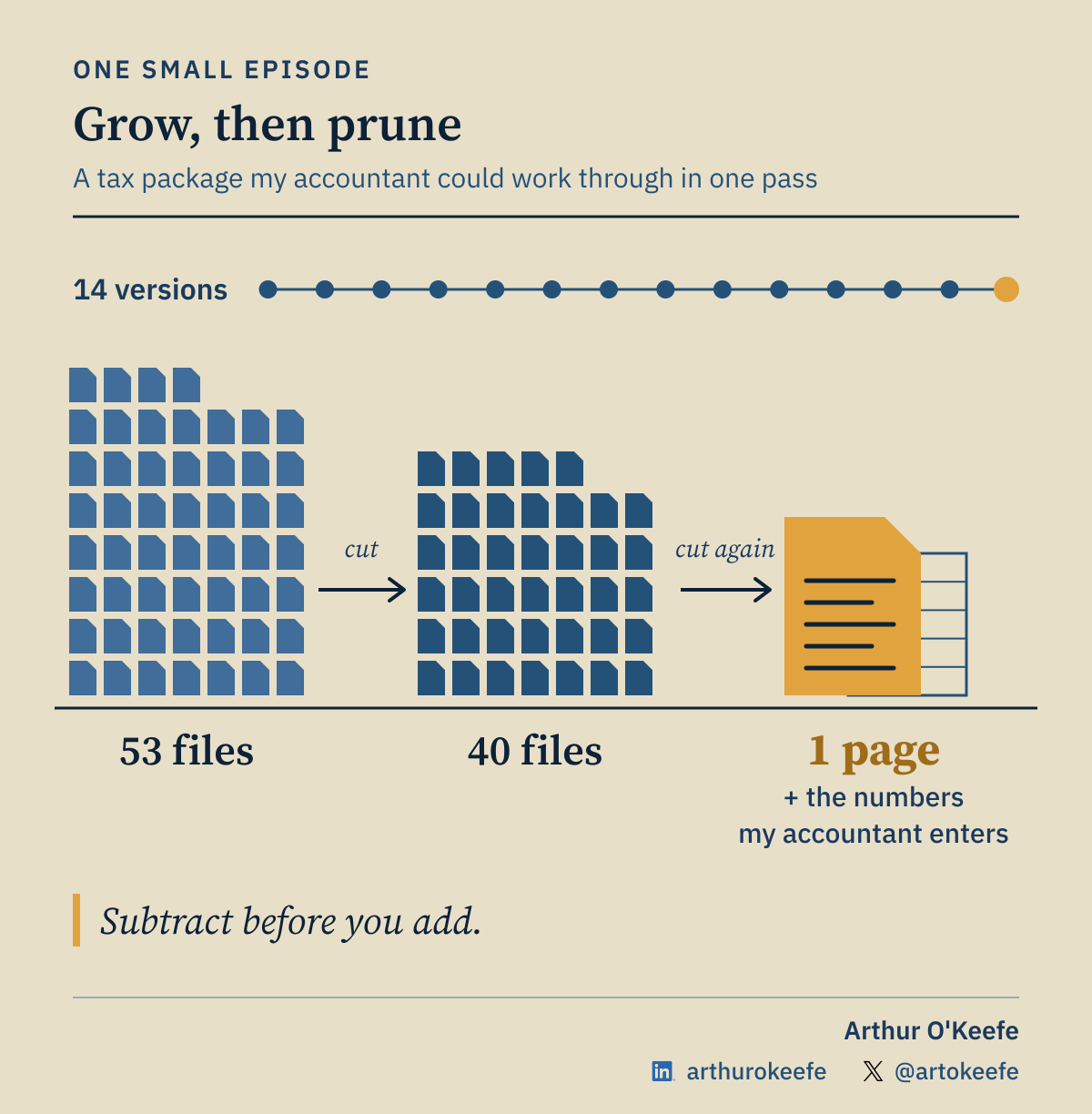
Grow, then prune. You let the hedge run wild before you shape it. Subtract before you add. And once you've learned a thing this way, it's permanent. I'll never have to learn how to do that again, because the system remembers how, and so do I.
You can't plan the path
Much of the tooling I've built could be public. It wouldn't help you much.
What you can't download is the connective tissue: when to reach for which tool, for what, and why. That only comes from walking the map. You can clone my repository. You can't clone my six months.
Which is a problem, because I want to hand it to you.
The AMG ONE problem

In my last essay I wrote about the driver. This time I'm the engineer handing someone the car.
What I've built is, in effect, an AMG ONE: a Formula 1 engine in a road car that, by some minor miracle, somebody got approved for the street. Hand it over as it is and it won't start, or it handles badly, or it feels far too heavy. The person isn't missing anything. The car was tuned for someone who has already walked the map.
So that's my design problem, not theirs. The car has to be two cars. On a Sunday it's a classic Mercedes: quiet, gentle, forgiving, happy to take you to lunch. The day you want more, it's the AMG ONE, and it takes you places you didn't know you could go. In real life, nobody hands you the keys to a hypercar on your first day. AI changes that. It's one car, and it becomes whichever one you need, on demand. You tell it where to go. You don't have to know how to operate it.
Every business knows the old alternative. QuickBooks, then NetSuite, then SAP, each built for a single size, each migration so painful that companies put it off until the old system nearly broke them. A system of iteration starts small enough to fit the person you are today and grows with you, with no cliff to jump.
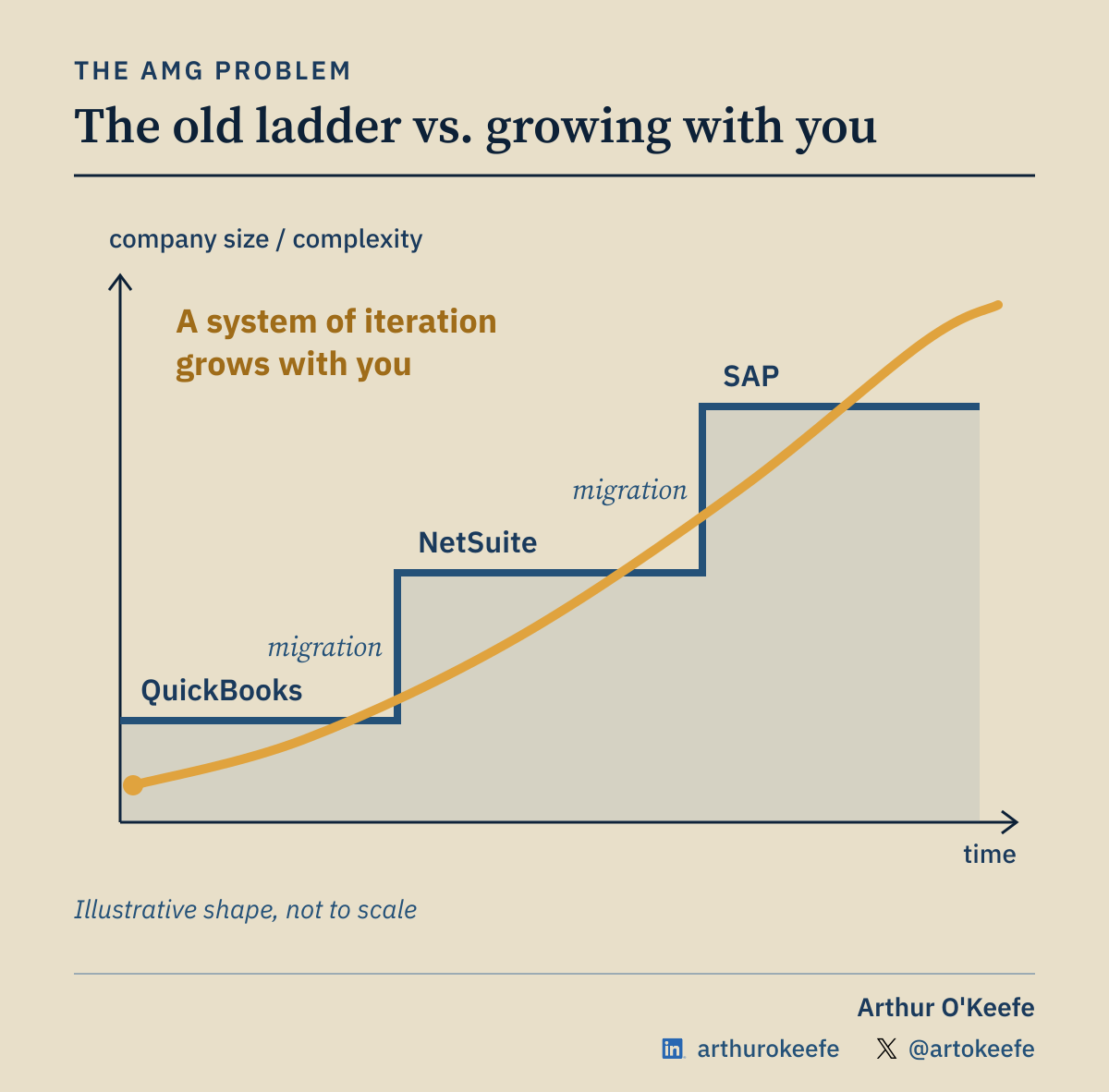
My job now is to make that happen abnormally fast for other people. They shouldn't need six months and 1,900 changes to get where I am. They should get there in a fraction of that, and then pass me.
The real test

Here's the part I care about most.
Turning graduates of Stanford and MIT into superheroes doesn't change the world much. It makes the economy more K-shaped: the top pulls further away from everyone else. I live in Brazil. I know what a country of haves and have-nots looks like up close.
The real test is the capable, non-technical person who runs a real business and will never raise venture capital. If that person can drive the car, something has changed.
Brazil already ran this experiment once, with money. The central bank launched Pix in 2020. About 186 million users are registered, and it carries billions of payments a month. A housekeeper is paid in seconds, at any hour, by a few taps to her phone number. No card machine is needed, and neither she nor her employer has to know the central bank runs the rails. They just use it, and their day moves faster.
That's the standard: adoption without comprehension.
The research on AI says the same thing in a more careful way. When the expertise lives inside the tool, the biggest gains go to the least experienced. In Brynjolfsson, Li and Raymond's large customer-support study, novices improved by about a third. When the user has to supply the judgment, the gap widens. So the K is a design variable, not a law of AI. Whether this lifts the bottom or only the top depends on what we build.
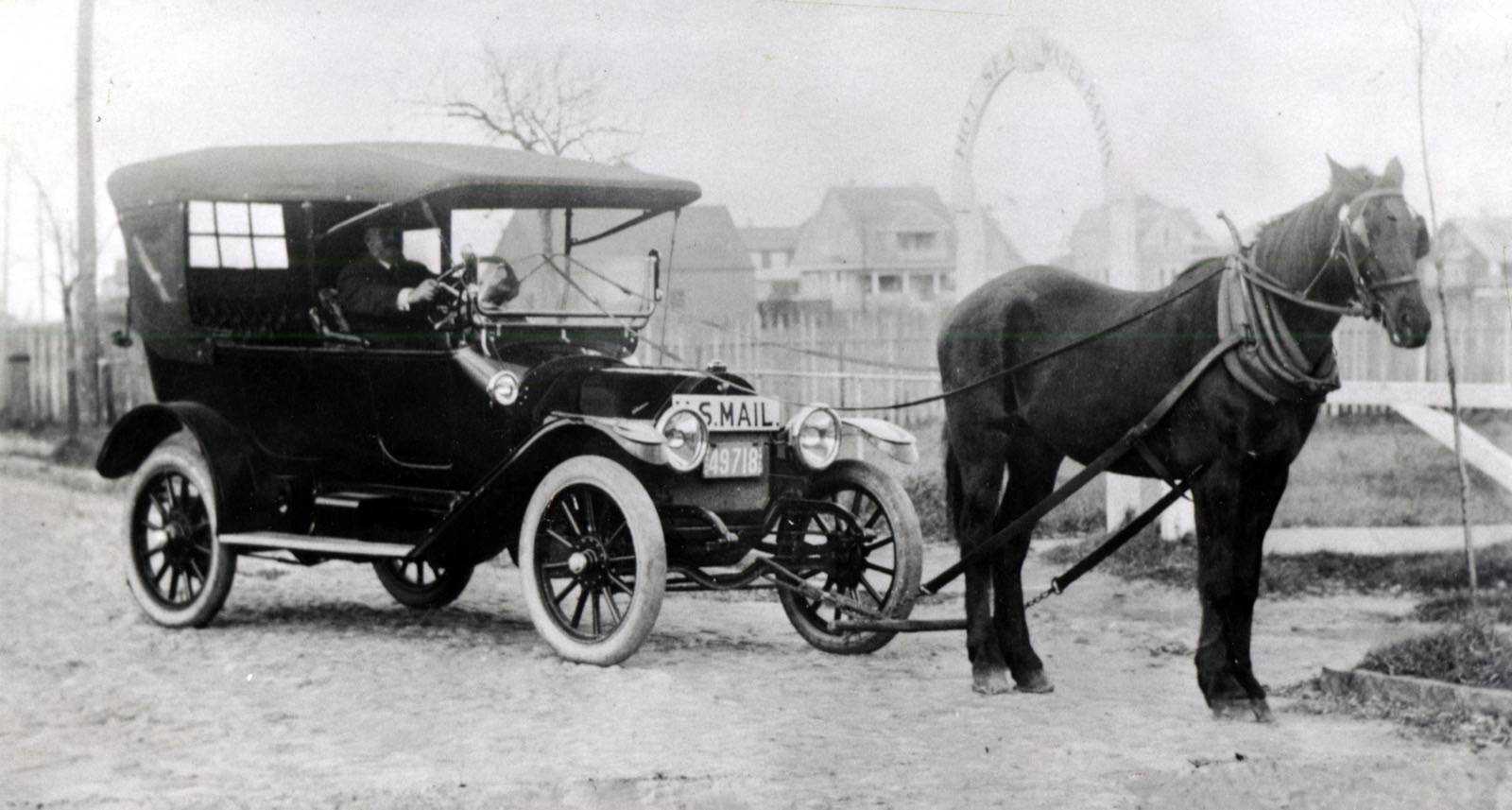
First the horse pulls the car. Then you let go of the reins.
An ERP doesn't iterate with you. Most advice, and most capital-raising, was built as a few big, expensive loops, because every loop was expensive.
When loops get cheap, the valuable thing becomes the partner and the system that iterate with you and help you decide where to go next, sometimes somewhere you didn't plan. Structuring credit has always been that kind of back-and-forth with a company until the right structure appears. That's the direction of my own firm. Bamboo DCM is an independent structurer and distributor of corporate and structured credit in Brazil, helping mid-market companies raise capital from institutional investors. It's building toward an agentic credit firm, with systems meant to carry more of the analytical and operating work while the people who lead each domain stay responsible for decisions and verification.
And we can't yet see most of what this permits. Benedict Evans has the line for it: it was easy to predict mass car ownership and hard to predict Wal-Mart.
What we can see is the shape of the switch. Look at the photo at the top of this section. The car is already there, and a horse is still pulling it. That's what a technology change looks like from the inside: for a while the old and the new live together, and it looks a little ridiculous. Then it switches over, and it doesn't switch back.
Before the Paris Olympics, my son and I walked through France's national car museum. It has stayed with me ever since. We like to think of evolution as gentle, one form easing into the next. Often it isn't. Some carmakers made it across; the coachbuilders' craft mostly didn't. Extinction is far more common than anyone likes to talk about, because it's sad. Someone can put a whole life into a way of working that becomes obsolete, with no missing link and no path across. I'm no anthropologist, but our own species lived alongside the Neanderthals for thousands of years, and today most of us carry only a trace of them. I think about what that cohabitation felt like near the end.
Cry “Havoc!” and let slip the dogs of war
Shakespeare, Julius Caesar, Act 3, Scene 1

This moment makes a demand on us. Nobody goes straight from a horse and buggy to an AMG ONE. You learn what speed feels like first. You run the horses and the motor together, you go a little faster, and one day you let go of the reins, let the horses go, and just drive. The time to build and learn is now, while the horse is still pulling. Because what comes next is a revolution you'll have to drive at the limit, the way Gandalf rides Shadowfax to Minas Tirith: flat out, with no time left to learn the horse.
I know what the limit feels like. On the submarine, when we ran fast, nobody needed a gauge to tell them. Everything shook. You heard it, you felt it through your feet, and every system had to hold right at the edge of what it could do. You don't get there on your own, and you don't get there without practice.
And it isn't a race against other people. Nobody here is fighting for pole position. Everyone in the pack gets the podium. You just have to be in the pack, and you have to have practiced enough to enjoy the ride.
Where it breaks
Speed isn't direction. In METR's controlled study, experienced developers using AI were measured to be slower while believing they were faster. The feeling of speed is not proof of it.
Forks without merges scatter you. Every open branch competes with the one you're supposed to be on, and a system that only helps you diverge has left out the half that matters. The merge is the point.
And if you delegate everything, you skip the loop that makes you stronger. The path is the power-up. A system of iteration only works if you stay in it.
Chega

A few numbers from this essay itself. I dictated about 14,000 words into it: voice notes, early-morning monologues, second thoughts, the stories I threw away. The machines produced something like 280,000 words of research, drafts, verdicts and arguments with each other. What you just read is about 2,650.
I wrote all of it on my phone. The Mac mini on my desk at work has no keyboard and no monitor; it's a server I only ever reach remotely, even when I'm sitting next to it. My agents kept the work there, Claude did the thinking, and when the essay needed a cover illustration, a request went off to Codex and came back. I built that tool once and never think about it now. I didn't do any of the grunt work. I talked. I imagined, got excited, now and then got emotional, and the system was the exoskeleton that turned it into what you just read. It's the most liberating part of all of this. It's an AMG ONE at the red line.
It could be better. There is always a next turn. At some point you have to say chega, Portuguese for "enough," and ship. Shipping is a loop too. The next essay will take fewer of my words, because this one now exists for the system to build on. That's the compounding, measured.
The powers already arrived. Nobody gets the whole cape on day one. You get an episode, then another. Every one of mine started with being wrong. Every one left the work waiting when I came back, and me a little stronger.
That's a system of iteration.
Arthur O'Keefe is Founder and Chief AI Officer of Bamboo DCM. A computer engineer by training, he has operated a nuclear reactor as a U.S. Navy submarine officer, built financial systems and helped build Movile and iFood as Movile’s Group CFO and Chief Strategy Officer. He builds systems of iteration and writes about the engineering and operating judgment that make them useful. A system of iteration is AI you can push back on. You can run it flat out for a weekend or park it for a week, then find the work waiting where you left it.
About Bamboo DCM
Bamboo DCM is an independent structurer and distributor of corporate and structured credit in Brazil, helping mid-market companies raise capital from institutional investors. It is building toward an agentic credit firm, with systems intended to carry more of the analytical and operating work while domain leaders remain responsible for decisions and verification.