AI doesn't free you. It needs you free to live.
By Arthur O'Keefe, Founder and Chief AI Officer, Bamboo DCM
Published on
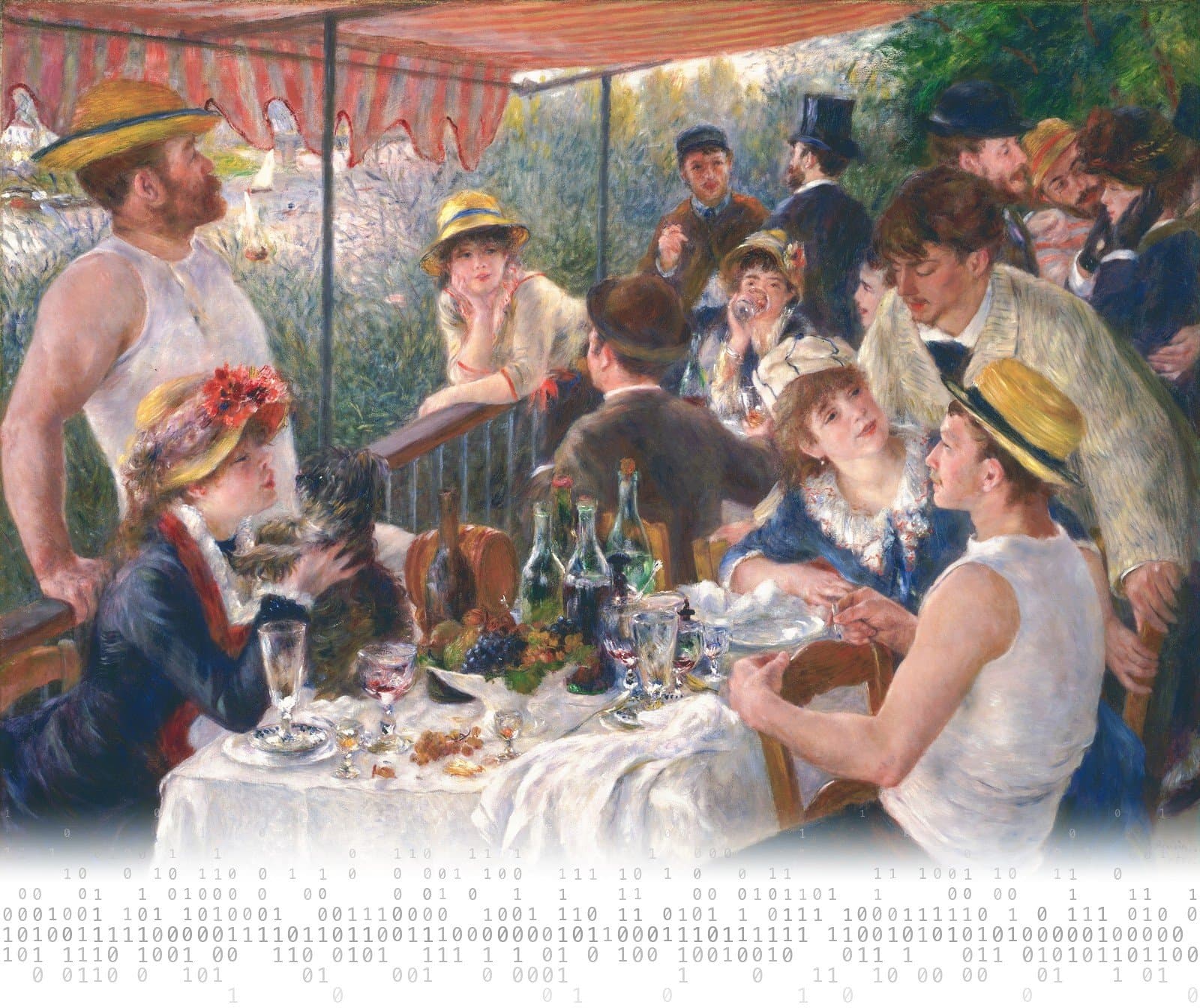
A regulator's visit made me hand my routine to AI. What came back was time, and a record that keeps finding new uses, for me and for the people I meet.
It takes the tasks. I take the living. Pierre-Auguste Renoir, Luncheon of the Boating Party, 1880–81, The Phillips Collection, Washington (public domain). Below the table it dissolves into a layer of code made for this essay.
In March a letter arrived from ANBIMA, a self-regulator for Brazil's capital markets. In three weeks a team from ANBIMA would come to our office to hear, in person, how the firm works.
To be ready I needed more than a dozen manuals, in Portuguese, a language I write badly. A presentation. And a script, so that when I opened my mouth in that room I said what the firm is and nothing it isn't. All of it about a firm that is complicated even to the people inside it. Three weeks, on top of the day job. The thing that can't slip, on top of everything else that can't. So I handed the routine to AI, one task at a time, and spent the hours it gave back building one view of the whole firm, in one place, that could produce a manual, a slide or a line of script on demand. It went better than I had any right to expect.
Here's the pact I've made with AI. It takes the tasks. I take the living. And what I live becomes what it works with next. If you use AI at work, you're already in the first half of that pact. The second half took me months to understand.
The relief when the tasks went to the machine
The story starts a little before the letter. Our compliance officer had left. I looked around for someone to take the role, found no one, and took it myself. I've worked in securities markets for a long time and I'm not junior at any of this; I could make the decisions. Learning the details of compliance in Portuguese, with its reporting calendar and its forms, and then doing it all, was another matter. So I did the minimum.
Then the letter came, and the minimum stopped being enough.
The machine became my Sherpa. It read every rule we live under and put each one beside the policy that answers to it. It told me which policies were missing. It asked me questions until it understood how we actually work, then helped me draft the policies and the manuals, in Portuguese. It guided me through the tracker, the handout, the deck and the script. Even our written answers to ANBIMA's team started as drafts we worked on together. I would never have climbed that mountain without it. But I still carried the pack. I decided to go. I paid for the expedition.
What I did was the living. I read what came back and said no, or not like that, or yes. I sat with Amanda Pires and her operations manual, which turned out to be what the whole visit rested on. Amanda heads our structured finance. She works out the deal a company can actually bring to market, shapes it into something investors will buy, and signs off on every structure before it leaves the building. I talked to our lawyers. On every point where the firm had to have an answer, I decided what the answer was. That part never went to the machine. It's the part that matters, and it asks for nothing special: read what came back, and say no.
And I felt relief. Those were the jobs I had been doing slowly, at night, in a language I write badly. There was no living in them, and I had stopped noticing how much of mine went into getting them done. Watching them go was like putting down a bag I had forgotten I was carrying.
It wasn't perfect. Months later I found a wrong company registration number in one of our written answers. The machine had made it up. I had let it through. That mistake became a rule my agents still work under: every fact must point to a source I can check. Relief is no substitute for checking. I think it was close to the last time a made-up fact got past me. If I had to pack one rule for the next expedition, it would be that one.
We passed. ANBIMA's team closed with a letter asking for very small corrections. We looked good in that room, better than I expected. And what I had built to survive three weeks became what I do now: hand over the routine, use the hours to build what the next task will need, repeat. I stopped treating it as a rescue and started doing it seriously.
My past started coming back to me
The morning of the visit, the deck wouldn't export. After all that work, I printed it from a browser at seventy percent zoom and walked into the room with paper. The paper did its job. That afternoon I went back to the file, and instead of fixing it, we fixed something bigger.
Urian Inhauser is one of our co-founders. He runs our outbound marketing, leads our market-data reports, and builds his own agents to read the market from what Brazil's securities regulator publishes. He saw that I was fighting the wrong thing. The problem was never my file. My agent looked at a presentation we already used for deals and found three design systems in use inside the firm, disagreeing with each other, and every finished deck still had to squeeze through PowerPoint or a browser print. So instead of patching one deck, I opened a project to make presentations in code, for the whole firm, and the deck I had made for the visit became its first user. Within two weeks Urian had settled which of the three designs was the real one and published a design tool on top of it, and the firm has drawn on it since. I had gone in wanting a file I could send. We came out with a way to make every presentation after it.
Why the whole firm, and not just my file? Because those weeks had shown me something. Word was becoming the place I looked at a redline. Excel was becoming the place I checked how a number was calculated. Both were turning into display tools. The making was moving into code and into my voice, and the display was the browser. The slide deck, I thought, would go first. So the deck that wouldn't export wasn't a broken file. It was the first of the old tools going out the door. The test works on any desk: whatever only gets looked at anymore is next.
Here's the part I still find strange. Months later my agent came back from some other task holding a document made with Urian's tool. I had never seen it. I had never asked for it. I still don't know where it's stored, and that's the part I like. Something I helped start had gone on without me, become useful to someone else, and come back when I needed it.
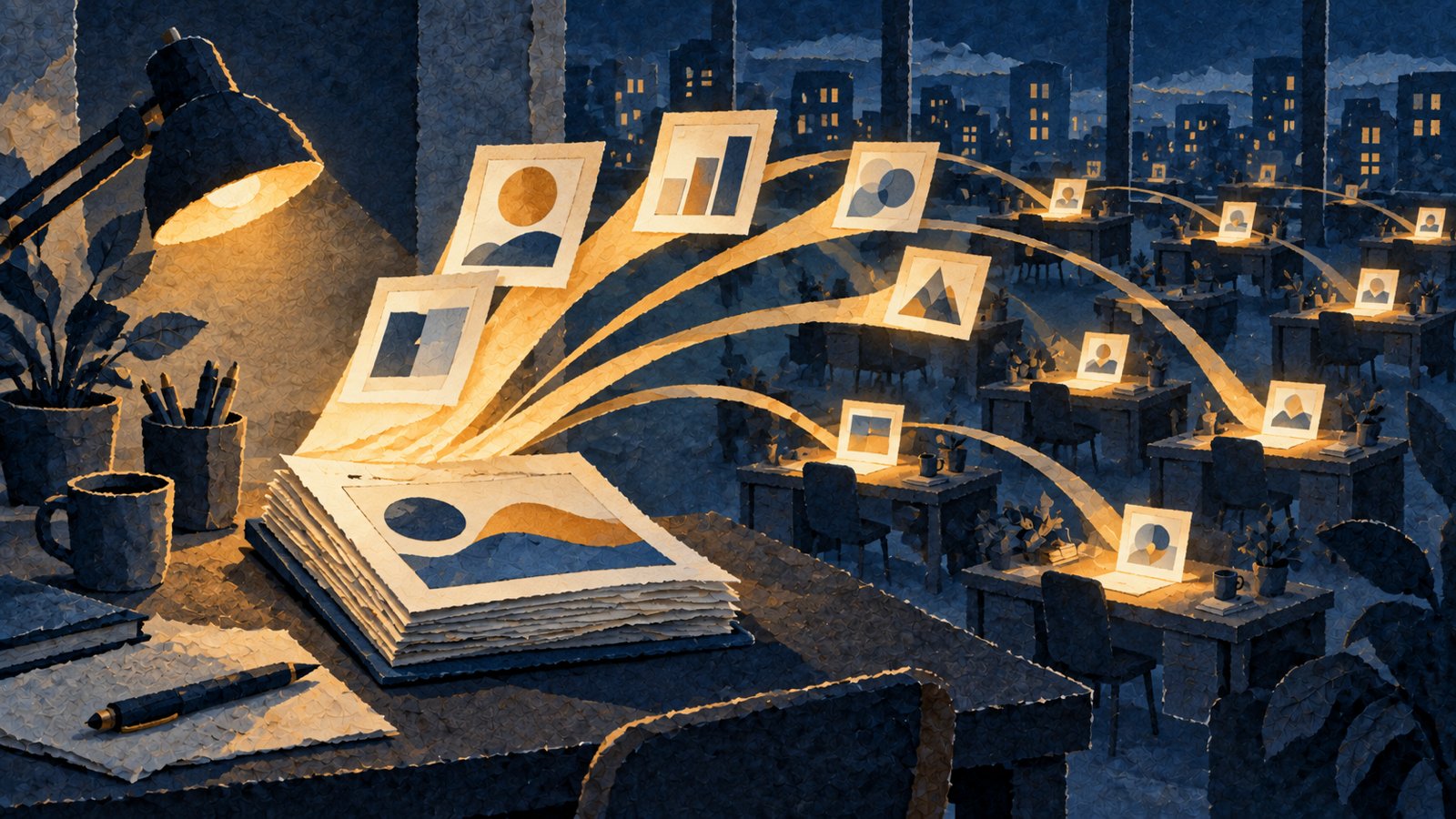
It kept happening. The generator we built for the visit's formal documents now prints the minutes of our corporate meetings. The compliance folder became the floor of a workspace colleagues install by pasting one prompt into the AI they already use. None of it was planned. I had just kept what we built. Keeping is a habit, not a project.
It corrected my memory
The strangest thing happened while I was writing this.
I remembered the visit as the beginning of everything. So I asked my agent to go through the records, the change histories and the correspondence, and rebuild what I had actually been doing before the letter, during the preparation and after.
The record disagreed with me. The compliance library was older than the letter. I had started it a month earlier, for the year-end reports, and my memory had folded the two together. The machine could give me the date. It couldn't give me the reason, and that part came back only once the date made me look: the officer who had left, the role I had taken, the reports I had to get out. I had lived both parts. I had forgotten how they joined.
Every date in this essay is the record's. Every reason is mine. That is the second half of the pact, happening in front of me. I lived through April. I kept it. Six months later the machine handed me back my own past, corrected. It can do that for anyone with a record to read. The dates will be the record's. The reasons stay with whoever was there; no machine can supply those.
The living is what it works with
You've heard the line: AI frees you for meaningful work. I understand the appeal. I felt the relief. But the line has the direction wrong.
AI doesn't free you. It needs you free to live what it can't look up. It's a tool, and a tool is not fire-and-forget. The model already holds a great many other people's published lives. What it can't get on its own is the unpublished part: your week, the thing that failed inside your firm, the person you met, the afternoon you finally understood how something works. Nothing from my afternoon with Amanda and her manual is on the web. The model gets it only if I keep it. Your path, and the paths of the people you know, are the missing links. Anyone can rent the model. Nobody else has your week.
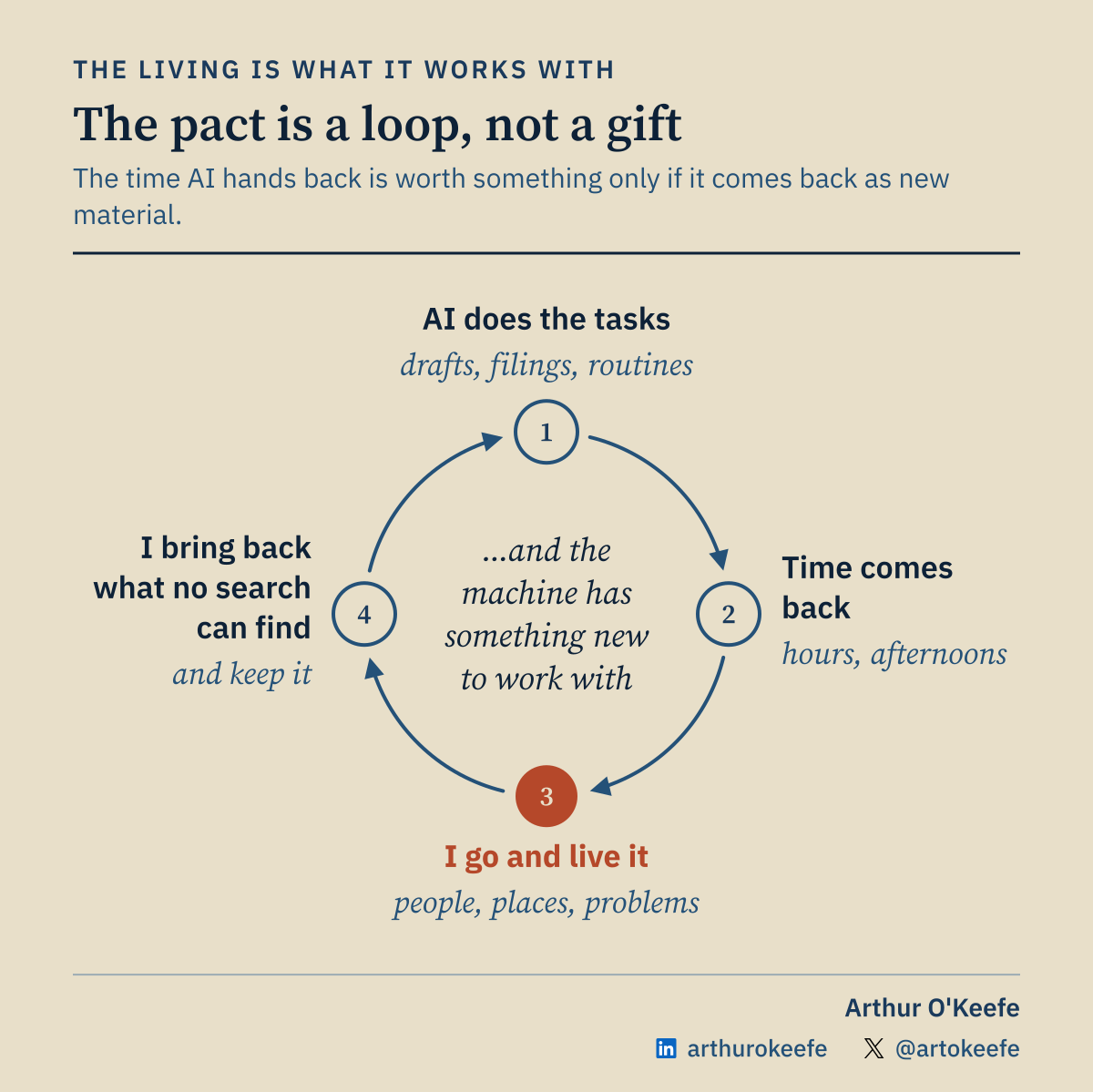
So the pact runs both ways. It does the tasks, the operations, the routines. In return I keep working on the how and on what matters next, and I do that by getting away from the desk and engaging with people, who have tried what I haven't and can see what I can't from where I sit. Then I bring that back, and the machine has something new to work with. The time it hands back is not a gift. It's a loop. Filling every hour of it with more of the same tasks would miss the point. The hours are for wherever the machine can't follow.
A repetitive "job" is anti-life
It turns out what everyone always suspected is true. A "job" is anti-life. Not work: work can be the best part of a week. I mean the "job," the same thing done the same way, week after week.
I mean it almost literally. The more of my week was a "job," the less of it I was living, and the less of it AI needed, because AI can do "jobs." I had got very efficient at having nothing new to bring back. What AI can't do is find private knowledge, and private means exactly that: it lives in a person. It isn't on the web. No search will surface it. Somebody has to decide to hand it to you, usually across a table, and so far nobody has invited my agents to lunch.
In my last essay I wrote about Zelda: the map starts black, you hit a locked door, you go clear a side quest, you find a key, and the door opens onto a whole new region. This time, think about who holds the key. AI can't get through every locked door. Read the stories about agents going wrong and many of them are the same story: a machine at a door it was never given the key to, trying the handle. The key is held by a person. Sometimes you get it only by sitting across from that person and working something out. They have to trust you. You have to understand what they need. That's how it should be.
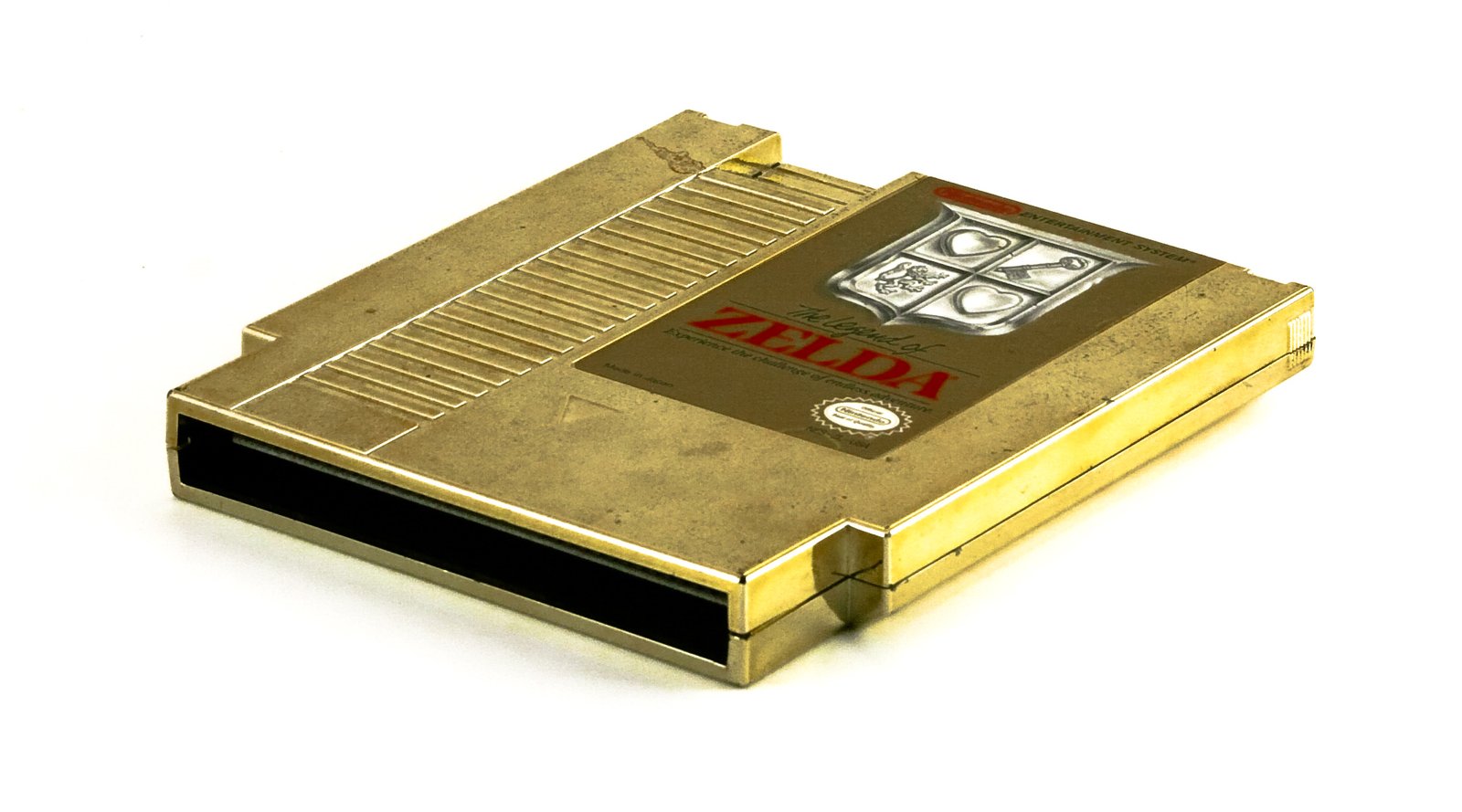
That's your role. You cross the map. You open up a region. Then your agents run through it, and they're very fast once they're inside. It's a game, and a better one than a "job": what can I open next, what can I bring back, who holds the key to that door?
And it isn't selfish, because the keys mostly come by giving. Nobody hands you a key for nothing. You bring a piece of the map they don't have. You bring a capability. Sometimes they don't want to give you the key at all; they want to walk through with you, and the region gets explored by both of you. Good.
It happened to me in September. Everton Oliveira heads our technology. He builds the system our team runs deals on, keeps the firm's email agent running, and owns the data everything else draws on. He had started down a road that wasn't working. The only hint he had was: there exists something; go there and dig around. He pointed his agent at the workspace I had built, and the agent read the pages I had left open. He rebuilt the system on them and on our reference guidelines. I didn't know how far he had taken it. Felipe Moraes, one of our founders, asked in our team channel whether what I had shown that day was already in the system's foundations. It was the right question from the right person: Felipe leads our origination and investor relationships, and he sets where that system goes. I answered honestly that I didn't know. Everton answered for me. He had built on it. So yes. I had never sent him a page. I had left a key in a door, and his agent walked through. Every page ever written so a colleague could carry on without its author is the same kind of key.
Know what you bring
Which means you have to know your own currency.
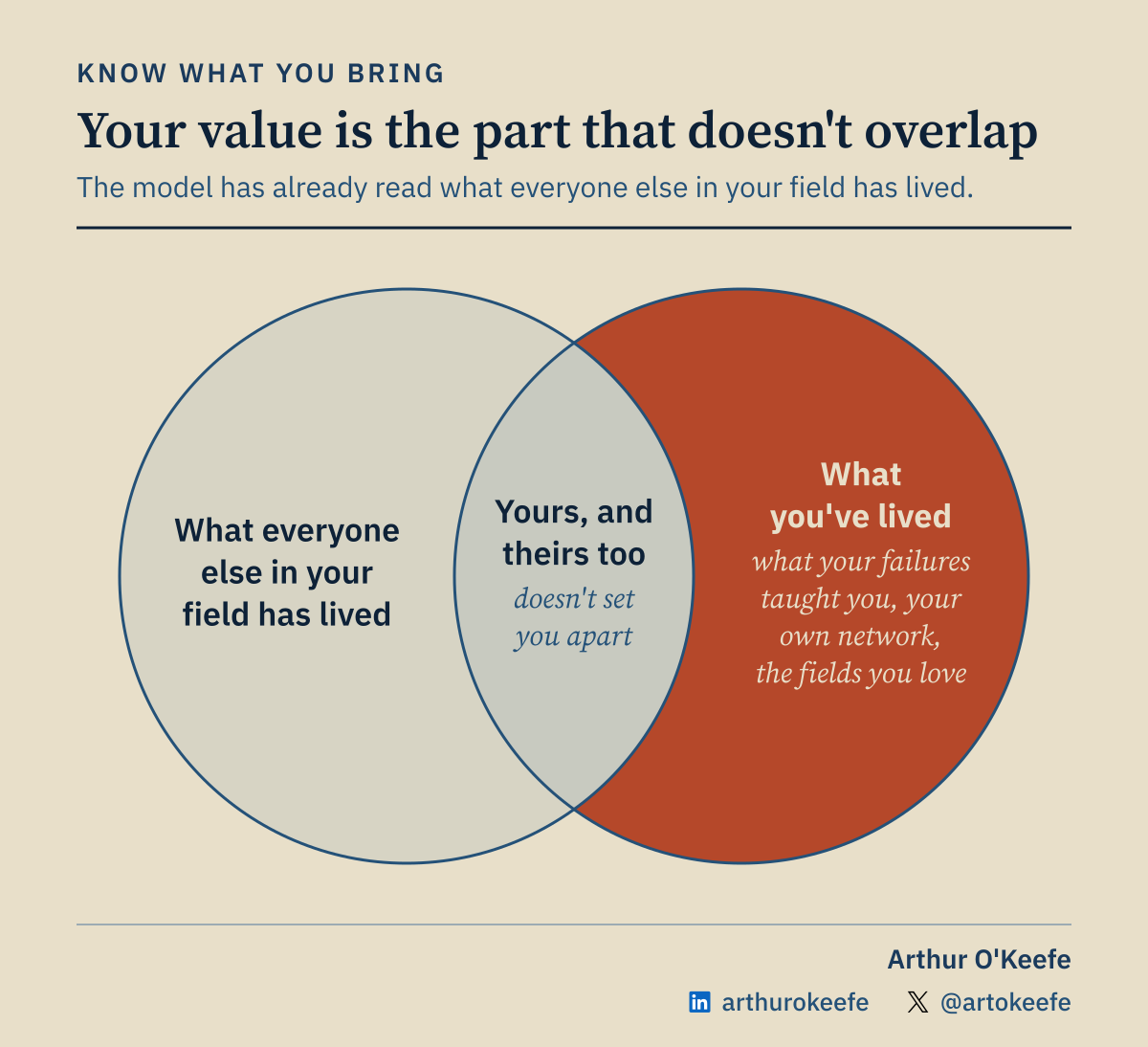
The interesting life makes the interesting record. If what you've lived is what everyone in your field has lived, you're the overlap in a Venn diagram, and the overlap doesn't set you apart. The goal is to sit at an angle to everyone else: additive, different, holding the piece they don't. What your failures taught you. Your own network of people. The fields you love that they've never entered. That's how you get access to the keys you want, and you have to recognize that you have it.
So what I keep is three things: what worked, what failed, and who I met. One page each, in plain words, when something ends. The failures matter most. They're the part of my past nobody else can look up, and the part most likely to save someone the year I spent learning it the expensive way. That's as true of other people's failures as of mine. People have kept notes like this for as long as there have been notebooks. What changed is what can read the notebook. A machine can go through pages I haven't thought about in months and notice that one belongs beside a problem I met this morning.
Biologists have a word for a thing built for one job that turns out to do another: exaptation. I'll use it once, and I'll take my example from a car. In the early 1960s Corning made a strengthened glass for windshields. Carmakers mostly didn't want it. It found a few small uses, then went quiet. Then phones became all screen, and the screens scratched, and Corning went back through its own past, found the old work, and built the first iPhone's glass from it. The glass was always worth something. What it had been waiting for was a need, and the need sat in another company's future. A kept thing met a new use because somebody remembered it was there. That is what a plain page and a machine that can read it are for. I don't have to predict the second use when I write down the first. Neither do you.
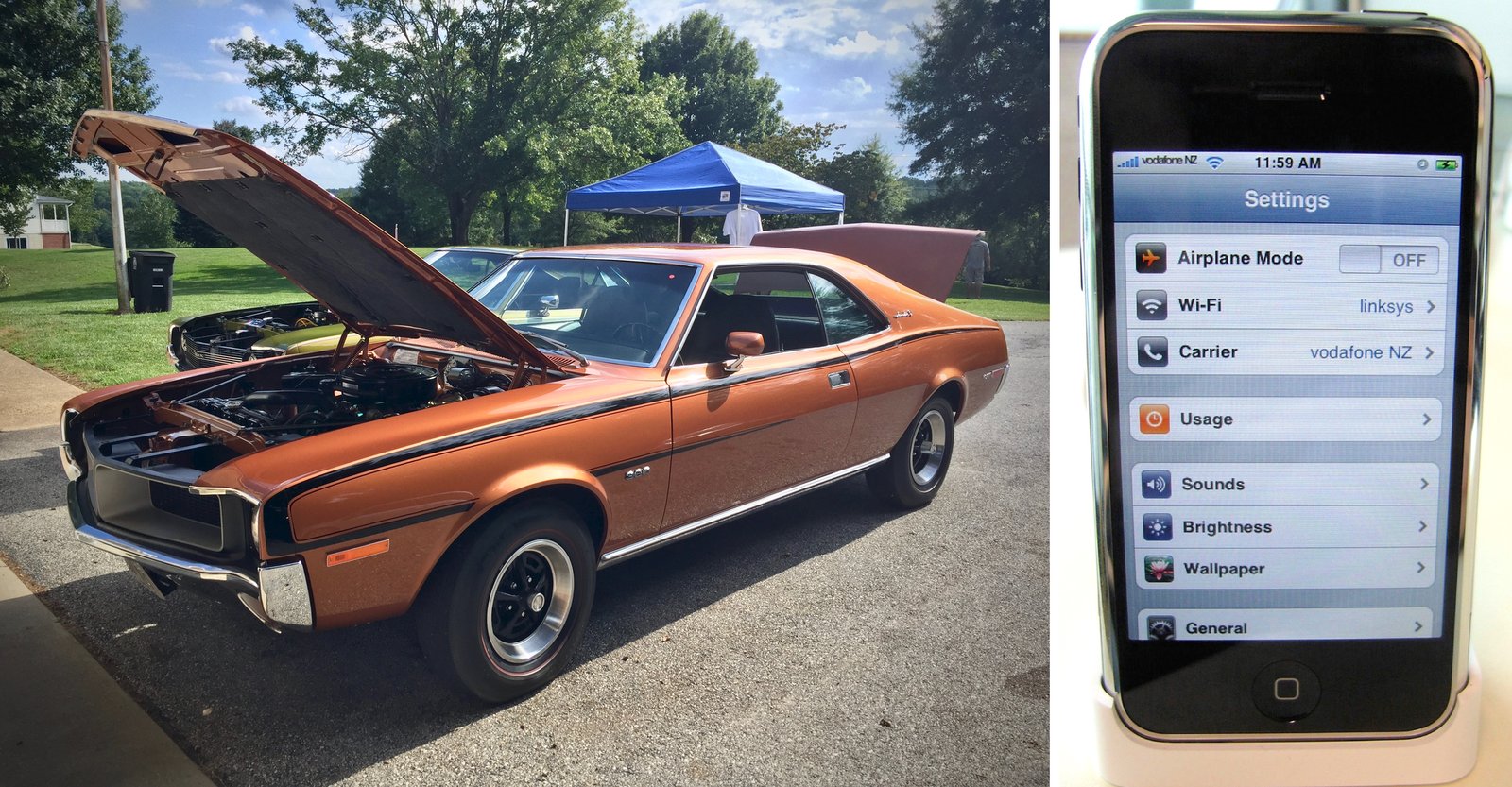
Keep it where your rules allow; the page's first reader is you. Then, when someone brings a need, you ask one question before you say a word: do I have a piece of this? The answer is yes more often than it looks.
Live, and keep it
Before the Paris Olympics, my son and I spent an afternoon in the Musée National de l'Automobile in Mulhouse. It holds the Schlumpf Collection: more than four hundred and fifty cars inside a former wool mill. The car my son remembers is the Bugatti Veyron. What stayed with me were the coachbuilt cars, their bodies hammered into shape over wooden forms by a craft that mostly didn't make it into the next age of cars.
I wrote about that afternoon in my last essay. I've now used it twice. One walk with my son, written down once, has done work in two essays, neither of which I went to the museum to work out. That's the pact in miniature.
I didn't know, walking through that mill, what it would be useful for. I don't need to. Turning every afternoon into a hunt for material would be a strange way to live. I want to be in the museum with my son, noticing what interests us. Later I can keep enough of it for something to come back.

In my last essay I said you could clone my repository but you couldn't clone my six months. I mean it more sharply now, and it isn't a claim about me: nobody's years can be cloned. The path is the living. AI takes the tasks along the way: the drafting, the filing, the version after this one. The files are there to be used; the judgment comes from having made them, tried them, been wrong and tried again. And the more you live and keep, the more your past is worth, to you, and to the people you meet who bring a need you turn out to hold a piece of.
Which is why I can say plainly what we are building. Bamboo structures and distributes corporate and structured credit in Brazil, and we build our own agent harnesses to do that work. A harness is the workspace an agent works inside: the rules, the records, the keys. We're also building a personal one, for colleagues who want to work this way. That's my part. Amanda, Everton, Felipe, Urian and the others bring their own paths, and the work gets more useful where those paths meet.
The machine can have the next task. I want to be there for the next afternoon. That is the pact. It takes the tasks. I take the living. And what I live becomes what it works with next.
A few numbers from this essay
I dictated and wrote about 15,000 words into it over three days: voice notes, corrections, second thoughts, the stories that didn't make it. About 3,100 landed in what you just read, roughly one word in five. Behind them sit more than 450,000 words the machines produced: research, drafts, rival versions, reviews and test readings, each counted once. Models from four companies did that work in more than 300 separate runs. Claude Opus 5.5 ran the process. Claude Fable 5.1, OpenAI's GPT-6 Astra, SpaceXAI's Grok 4.7 and Google's Gemini 3.1 Pro each wrote their own version of the story without seeing the others', and Fable then wove the best of them together. Simulated readers, investors and finance chiefs among them, read our key lines blind 96 times.
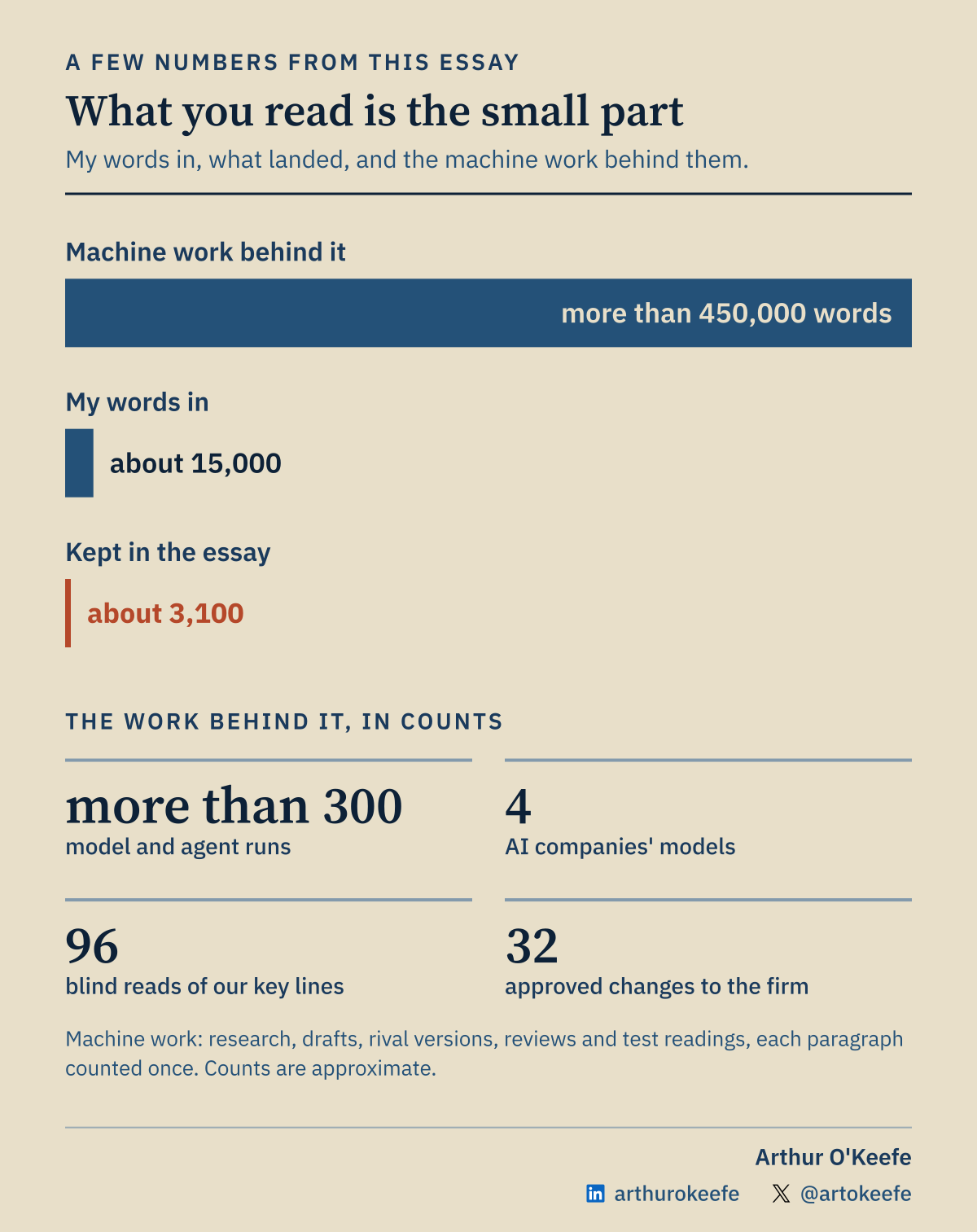
The essay also changed the firm. Writing it forced questions about how we describe ourselves, and the answers became 32 approved changes to our shared documents in three days: nine new versions of our positioning, three recorded decisions, and new rules for how we title, illustrate and check what we publish. My last essay took about as many of my words. This one took about three times the machine work, and made more than twice as many changes to the firm.
Drafting was the task. Deciding which words were true, which were mine, and which to keep was the living. I carried the pack.
Arthur O'Keefe (@artokeefe) is Founder and Chief AI Officer of Bamboo DCM (@BambooDCM). A computer engineer by training, he has operated a nuclear reactor as a U.S. Navy submarine officer, built financial systems and helped build Movile and iFood as Movile’s Group CFO and Chief Strategy Officer. He builds systems of iteration and writes about the engineering and operating judgment that make them useful. A system of iteration is AI you can push back on. You can run it flat out for a weekend or park it for a week, then find the work waiting where you left it.
About Bamboo DCM
Bamboo DCM is an independent structurer and distributor of corporate and structured credit in Brazil, helping mid-market companies raise capital from institutional investors. The firm builds its own AI systems for preparing and analyzing transactions; its senior people remain responsible for every decision.